A book by Professor Gordon Slater9 April 2026

Chaos to Creation Longevity and Regeneration Frontiers.

What if decline isn’t inevitable?

Exploring longevity, regeneration and the science reshaping how we age.

“Aging is a challenge to address rather than an inevitable fate to be endured.”
Chaos to Creation, p. 15
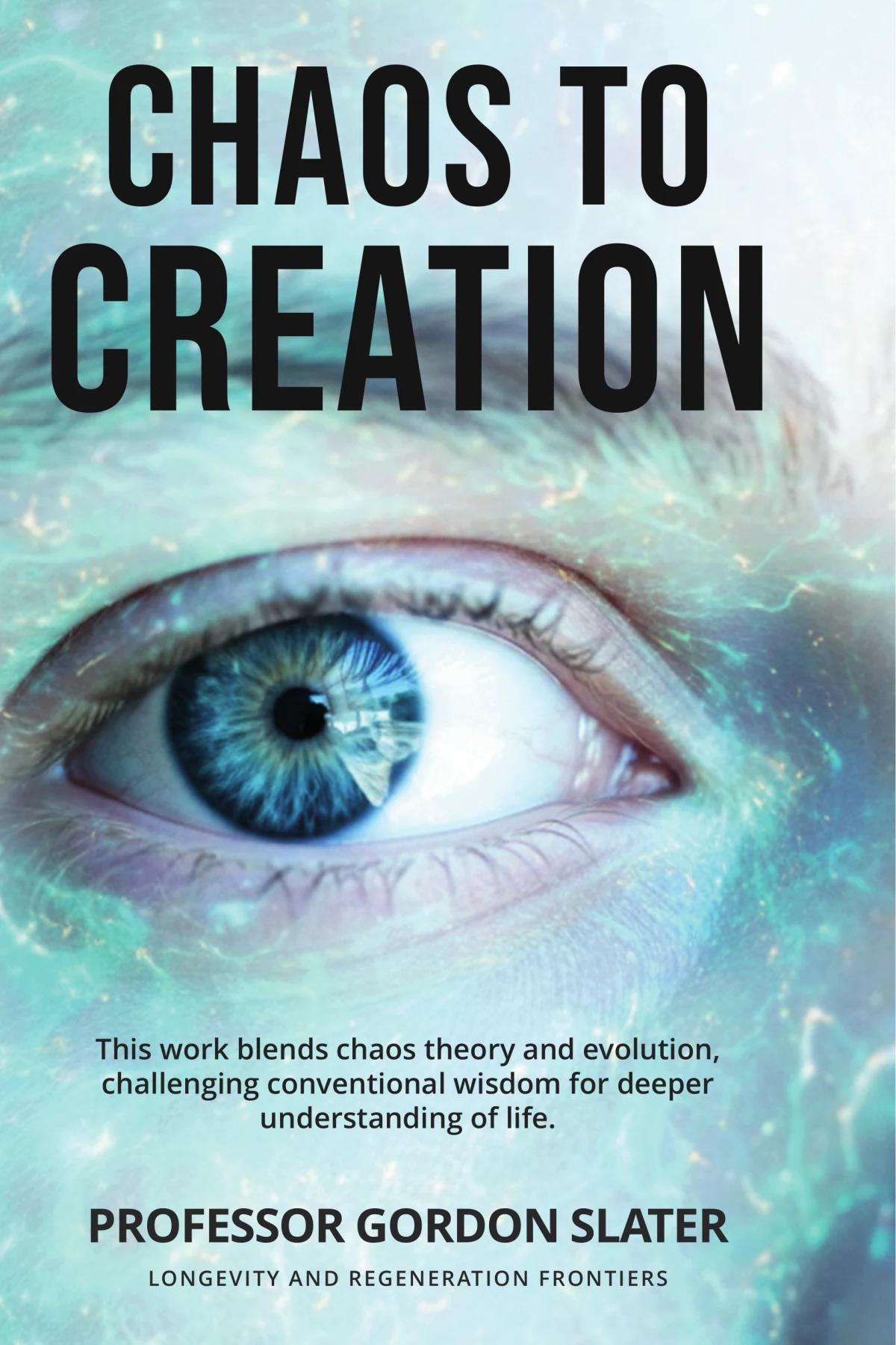
Chaos to Creation by Professor Gordon Slater — book cover.

ORIENTATION

What you'll explore.

A short orientation, lifted from the back jacket.

  1. 01

    How chaos theory and evolution reshape the way we see aging and regeneration.

  2. 02

    What nature’s "immortal" creatures can teach us about the body’s hidden potential.

  3. 03

    Which breakthroughs in regenerative medicine are real, and which ones are still being built.

  4. 04

    The simplest habits that can shift your health trajectory, starting now.

From the back cover

OPENING FRAMING

The central move.

Lifespan is not a predetermined clock but a modifiable outcome. The book opens by asking why some lifeforms live so much longer than others — and what the levers are.

Just as a civilisation as mighty as the Roman Empire did not fail all at once, the death of each organism occurs in different measurable stages.
Chaos to Creation, p. 14

Four guiding questions

  1. 1.

    What can we address with the data at hand?

  2. 2.

    What practical steps can we take to influence the outcome of our genetic inheritance?

  3. 3.

    What can we learn from nature itself?

  4. 4.

    Is it possible to question whether there are ways to do better than nature?

Chaos to Creation, p. 15

APPENDIX

The Life Force Formula.

The book's appendix is where Slater formally states his synthesis — a single expression for how regenerative capacity, damage, environment and inertia compose into a lifespan.

  1. LF
    Life Force — instantaneous vitality / regenerative potential. Highest at cellular inception; lowest at death.
  2. Ē
    Mean environmental / lifestyle envelope (diet, exercise, stress, toxin exposure, healthcare access, geography).
  3. R
    Net regenerative capability — autophagy, DNA repair, proteostasis, stem-cell function, telomere maintenance, immune renewal.
  4. D
    Damage — oxidative stress, mutations, DNA damage, mitochondrial dysfunction, protein aggregation, chronic disease, aging itself.
  5. I
    Biologic Inertia — resistance to regeneration; accumulated weight of past damage, disease, and metabolic wear.
  6. SAddition
    Stem-cell therapeutic input added to the system. Localised application is more effective than systemic.
Reading.Life Force = environmental envelope × (net regenerative work / inertia) + stem-cell input.

Chaos to Creation, Appendix pp. 220–226

THE THREE RULES

The three claims the rest of the book rests on.

Stated verbatim — the spine of the Life Force argument.

  1. 01

    Life Exists in a Constant Drift Toward Degeneration.

    “All cellular and biological systems are subject to entropy, accumulating damage over time. In order to extend life, we must actively slow or counteract this degenerative flux.”

    Chaos to Creation, p. 221

  2. 02

    Biologic Inertia Must Be Overcome.

    “Living systems in motion accumulate biological inertia — the weight of past damage, disease, and metabolic wear. This inertia can be overcome by a corrective input proportional to age and biological burden, followed by sustained support.”

    Chaos to Creation, p. 221

  3. 03

    Lifespan Is an Energy Balance, Not a Clock.

    “Biology is too complex to be reduced to a single equation. Still, we can outline the key variables that shape lifespan and describe how they interact.”

    Chaos to Creation, p. 221

Chapter 9 · Beyond Mortality

A median healthy lifespan of 150–200 years is achievable within this century — conditional on net regenerative capacity (R − D) staying positive over time.

The argument: senolytics, CRISPR, and epigenetic reprogramming have each shown 20–30% lifespan extension in mice. Combinatorially, these could push human healthspan toward 150–200 years — a 60–65% gain over Jeanne Calment’s observed 122-year human maximum.

This is founder-voice material. It is Slater’s hypothesis — not a clinical claim, not a treatment promise.

Chaos to Creation, pp. 209–218

EPILOGUE

Be a participant, not a passenger.

A short note from the author — out of the technical frame, into the so-what-now register.

  1. 01

    Aging is not abstract.

    It happens in real bodies on real mornings.

  2. 02

    The patient is a partner, not a recipient.

    Regenerative medicine does not work like antibiotics — the patient must do the environmental and lifestyle work while the clinician handles the pharmacology.

  3. 03

    Longevity is compounding, not heroic.

    One intervention does not extend life; a stacked, sequenced, sustained program does.

  4. 04

    Humility.

    Biology is too complex to be fully captured in one equation. The formula is a conceptual frame, not a predictive machine.

Biology is too complex to be fully captured in one equation.
Chaos to Creation, p. 221

CLINICAL CASES

Where the formula meets the bedside.

Two factual case panels referenced in the book and the published literature.

  1. 01

    Talus reconstitution

    A non-weight-bearing talus reconstituted to load-bearing form in eight weeks via 20 mL autologous mesenchymal stem cells with external fixation — a distraction-arthroplasty + biologics protocol producing documented cartilage regeneration in case-series form.

    Chaos to Creation, pp. 176, 202

  2. 02

    Brooker-4 diabetic ulcer

    A 60-year-old patient with a Brooker-4 grade diabetic ulcer healed in five HBOT sessions over three weeks, alongside minimally invasive surgery — illustrating HBOT as an adjunct in chronic-wound care.

    Slater, G. & Bachmid, Z. (2024) — "Application of HBOT with Minimally Invasive Guided Surgery to Heal Chronic Brooker-4 Diabetic Ulcer."

PRAISE FOR THE BOOK

From the book jacket.

Reactions to Chaos to Creation from beyond the author's own field.

  • “Chaos to Creation will change the way you think about life, aging and what it means to regenerate, essential reading for today and tomorrow.”

    Mark Bouris

    Entrepreneur & Investor

  • “Rarely does a book make science feel this alive — challenging, provocative, and utterly fascinating from first page to last.”

    Dr Marty O’Malley

    Associate Professor of Clinical Orthopaedic Surgery, Weill Cornell Medical College

  • “Deeply thoughtful and thought-provoking, addressing the elusive Fountain of Youth with evidence, explaining how close and how far we are from it and, most importantly, what is possible.”

    Dr Katherine Samaras

    Australian Centre for Metabolic Health

Chaos to Creation

“Lifespan is an energy balance, not a clock.”

Chaos to Creation, p. 221 — Rule 3