Teaching & academia
Professor at the University of Technology Sydney; collaborates with UTS biomedical engineering on the Life Force measurement workstream.
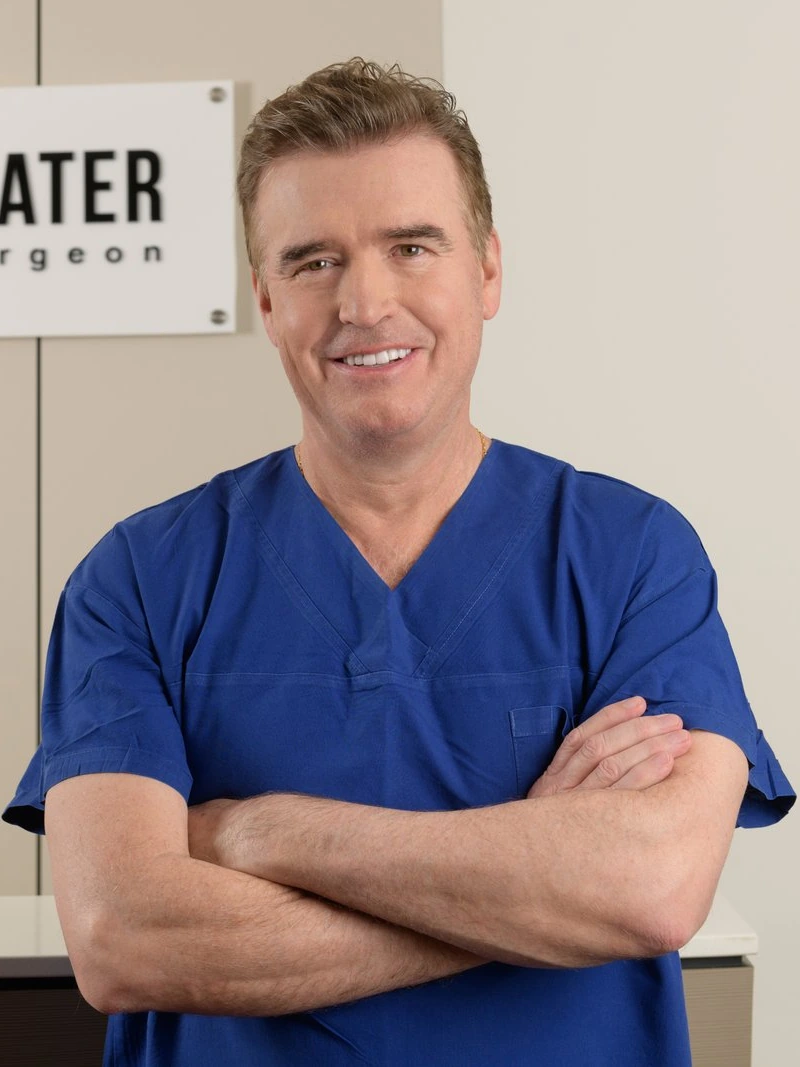
About · The story
Prof Gordon Slater is an Australian orthopaedic surgeon with a thirty-year clinical record in foot & ankle surgery, a growing body of peer-reviewed research, and active work in medical-device development. He was among the first surgeons in Australia to adopt minimally invasive techniques for the foot and ankle, and uses regenerative-medicine adjuncts where appropriate.
The through-line of the work is a single question: how does the body repair itself — and how far can that capacity be extended? What began in the operating theatre now spans genomics, biologics, and the biology of aging.
For clinical care or to arrange an appointment, please see the practice site — orthopaedic-surgeon.com.au.
01Medical training
From UNSW to the Hospital for Special Surgery in New York — a decade of training that ended where the questions began.
1983–87
The University of New South Wales
Bachelor of Medicine, Bachelor of Surgery. First player in tennis, squash and table tennis at Goldstein College; University Regiment infantry 1981–83.
1987
MBBS, University of New South Wales
1990
Royal Australasian College of Surgeons — Part 1 examination
1991
AO basic trauma course (55th), Davos, Switzerland
1992
Advanced AO Course, Sydney
1993
Early Management of Severe Trauma, St George Hospital
1997
FRACS (Orthopaedics)
1997
Advanced foot & ankle fellowship — Hospital for Special Surgery, New York
02Research journey
His research sits inside a wider Sydney ecosystem. Regular collaborators include UNSW’s Ramaciotti Centre for Genomics, the UTS Biologics Innovation Facility, the Garvan Institute, and the Westmead Institute for Medical Research — partners on the biomarker, methylation and biologics work behind the longevity and regeneration thesis.
He contributes to the international literature as Associate Editor of Foot & Ankle International, sits on the editorial panel of EC Orthopaedics, and chairs Foot & Ankle for the Asia Pacific Orthopaedic Association.
Professor
University of Technology Sydney
Associate Editor
Foot & Ankle International
Editor-in-Chief
Journal of Regenerative Biology and Medicine
Editor-in-Chief
Journal of Dental and Oral Research
Editorial Panel
EC Orthopaedics
Editor
CPQ Orthopaedics
Chair, Foot & Ankle
Asia Pacific Orthopaedic Association (APOA)
436 citations on Google Scholar · h-index 7 · i10-index 6
Hospital appointments: East Sydney Private Hospital · Albury Wodonga Private Hospital · St Luke’s Private Hospital
Recognition
Marquis Who’s Who in Medicine and Healthcare
2004–2006
Marquis Who’s Who in Science and Engineering
2004–2006
IBC Leading Health Professional of the World
International Biographical Centre, Cambridge, England — 2005
Engineering Awards Finalist
Anterior Fusion Plate
Letter of Gratitude, NSW Minister of Health
For participation in the Cowper bus crash response
03Innovation
Eponymous techniques, named devices, a peptide patent — and a book that gathers thirty years of it into one argument.
2011
Gordon Slater ankle-fusion plate
An eponymous hardware contribution to ankle-fusion surgery, published as a named device in the surgical literature.
2018–19
Slater modification of minimally invasive forefoot surgery
A planning and execution modification to MIS forefoot surgery — among the first MIS forefoot adaptations adopted broadly in Australia.
2021
Harvard University LBTech X1 — Technology Entrepreneurship: Lab to Market
Executive program with Prof. Karim Lakhani — the commercial grounding behind the device and biologics work.
2023
Hyperbaric Oxygen Therapy Course
Formal HBOT training underpinning the hyperbaric research theme.
2023
Peptide patent — cartilage regeneration cascade
Japanese filing JP2023106525A covering a peptide composition supporting cartilage regeneration.
2024
Integrant frame
External fixation frame used in distraction-arthroplasty + biologics protocols; clinical-utility paper published 2024.
04Longevity vision
Personalised biologics become tractable at scale when AI does the heavy lifting on molecular characterisation, trial design, and post-market surveillance — a thesis Prof Slater first set out in the 2019 paper "The Future of Medicine: Biologics and Artificial Intelligence" (Slater, Sambo & Hannan).
The right standard for getting there responsibly is the FDA–EMA Joint Guiding Principles of Good AI Practice (January 2026), the EU AI Act, and EMA Annex 22. The posture for Australian medical-device and biotech work: English-first product, anglosphere-first commercial rollout, regulatory-grown-up from day one.
05Future work
Professor at the University of Technology Sydney; collaborates with UTS biomedical engineering on the Life Force measurement workstream.
Associate Editor of Foot & Ankle International, editorial panel of EC Orthopaedics, and Chair of Foot & Ankle for the Asia Pacific Orthopaedic Association.
Actively building a research team in Sydney — around fifty recent biotech / AI-engineering applicants signal the shape of the local talent pool he is helping to grow.
A proud supporter of three Sydney charity events that fund breast-cancer, heart, and vision research — the Pink Luncheon at Royal Randwick, the Ingham Charity Raceday for the Ingham Institute, and the Black & White End of Summer Luncheon for Vision Australia.
See morePresents at international surgical conferences. MBBS, FRACS (Orth), FAOrthA.
Biology is too complex to be fully captured in one equation.